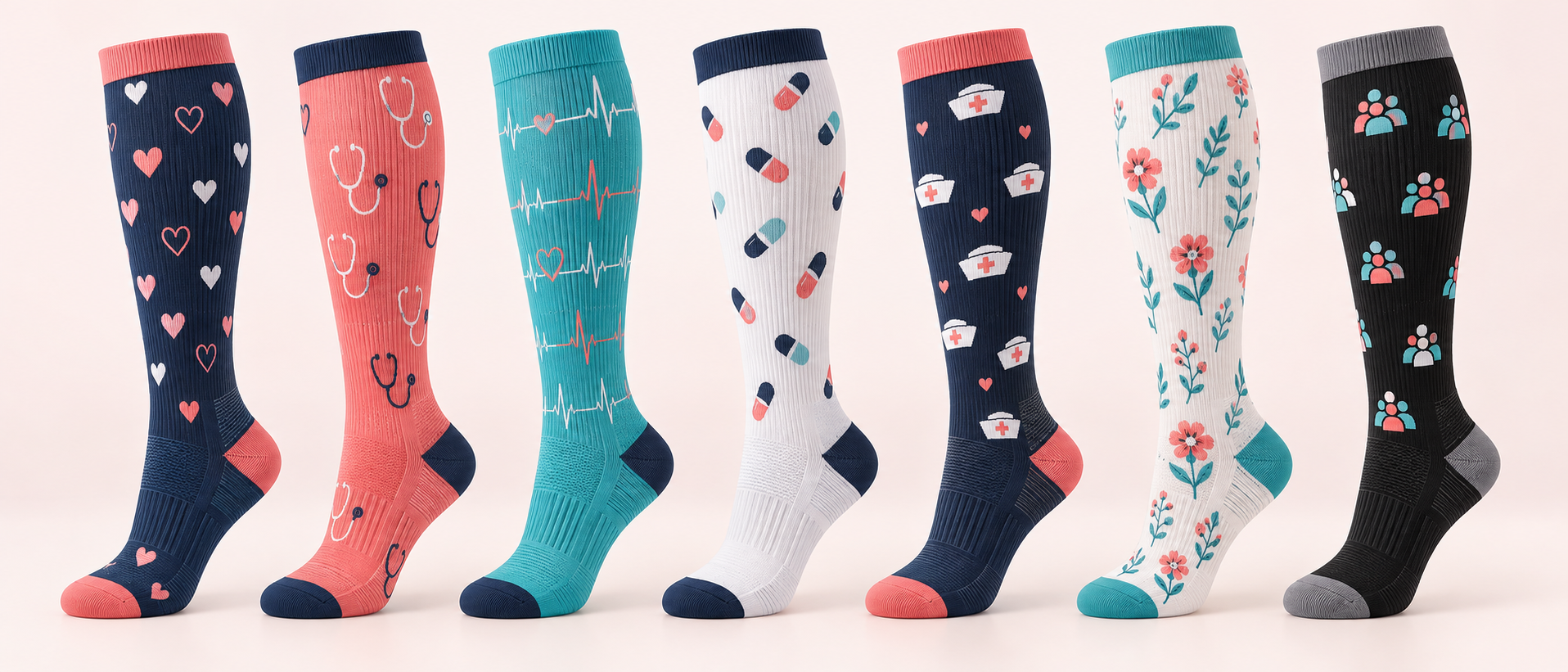
1. Define the nurse collection before drawing the pattern
Start with the buyer and retail channel. A nurse-uniform retailer, healthcare gift shop, pharmacy program, hospital team order, marketplace seller, and private-label wellness brand may need different color ranges, size architecture, packaging, and order quantities. Define the target customer, intended sales market, price position, compression direction, and collection size before artwork begins.
This step keeps the design commercially focused. Instead of producing many disconnected motifs, the buyer can plan a small coordinated range—for example, one healthcare icon group, one floral direction, and one quieter everyday option—with shared brand colors and packaging.
2. Build an original healthcare motif system
Custom nurse compression socks can use hearts, stethoscopes, syringes, capsules or pills, heartbeat lines, nurse hats, florals, team icons, initials, or original buyer artwork. The best brief identifies the main motif, supporting elements, background color, accent colors, logo use, and the overall mood of the collection.
Avoid copying artwork from another brand or marketplace listing. Supply original artwork, licensed elements, or a direction that the development team can translate into a new knit-ready repeat. The buyer should also confirm trademarks, professional symbols, or institution-specific graphics before approval.
- Choose one primary motif and a limited group of supporting icons.
- Provide color references rather than relying on screen appearance alone.
- State whether the logo should be part of the repeat, placed near the cuff, or kept on the packaging.
3. Design around the compression sock construction
A knee-high compression sock has functional zones that affect how a pattern appears. The artwork must work around the stay-up cuff, calf area, denser ankle support, shaped heel, foot, and toe. Motifs that look balanced in a flat square can stretch, compress, or disappear when translated directly onto the sock.
The development team converts the approved concept into a repeat suitable for the selected construction and size range. During sampling, review the sock both laid flat and worn so the buyer can see pattern scale, spacing, color contrast, logo legibility, and transitions around the heel and toe.
4. Coordinate sizing, materials, and retail details
The visual design does not replace the product specification. Confirm the size range, cuff and calf fit direction, compression program, fiber composition, heel and toe treatment, and care instructions alongside the artwork. Our stock material is declared as 65% nylon, 30% polyester, and 5% spandex; custom bamboo fiber, merino wool, and COOLMAX® programs can also be discussed with buyer-approved ratios.
Then connect the sock to the retail system: woven or knitted logo, size marking, pair band, hangtag, barcode, pouch or box, carton assortment, and any destination-market label information. Clear size identification is especially important when several patterns and sizes share the same packaging design.
5. Use the approval sample as the production reference
The sample should be checked for compression construction, fit direction, motif scale, color placement, cuff appearance, heel and toe position, material feel, logo, labeling, and packed presentation. Record the approved version so the factory and buyer are reviewing the same product when bulk production begins.
A useful RFQ includes the target market, compression direction, sizes, estimated quantity by design, motif references, color direction, material preference, logo files, packaging needs, and target date. This gives the factory enough information to propose a practical artwork and sampling route.
Bring the brief
Ready to make it sample-ready?
Share your healthcare motif ideas, target colors, size range, compression direction, quantity, and packaging plan. We can turn the collection brief into knit-ready artwork and a custom nurse compression sock sample for approval.