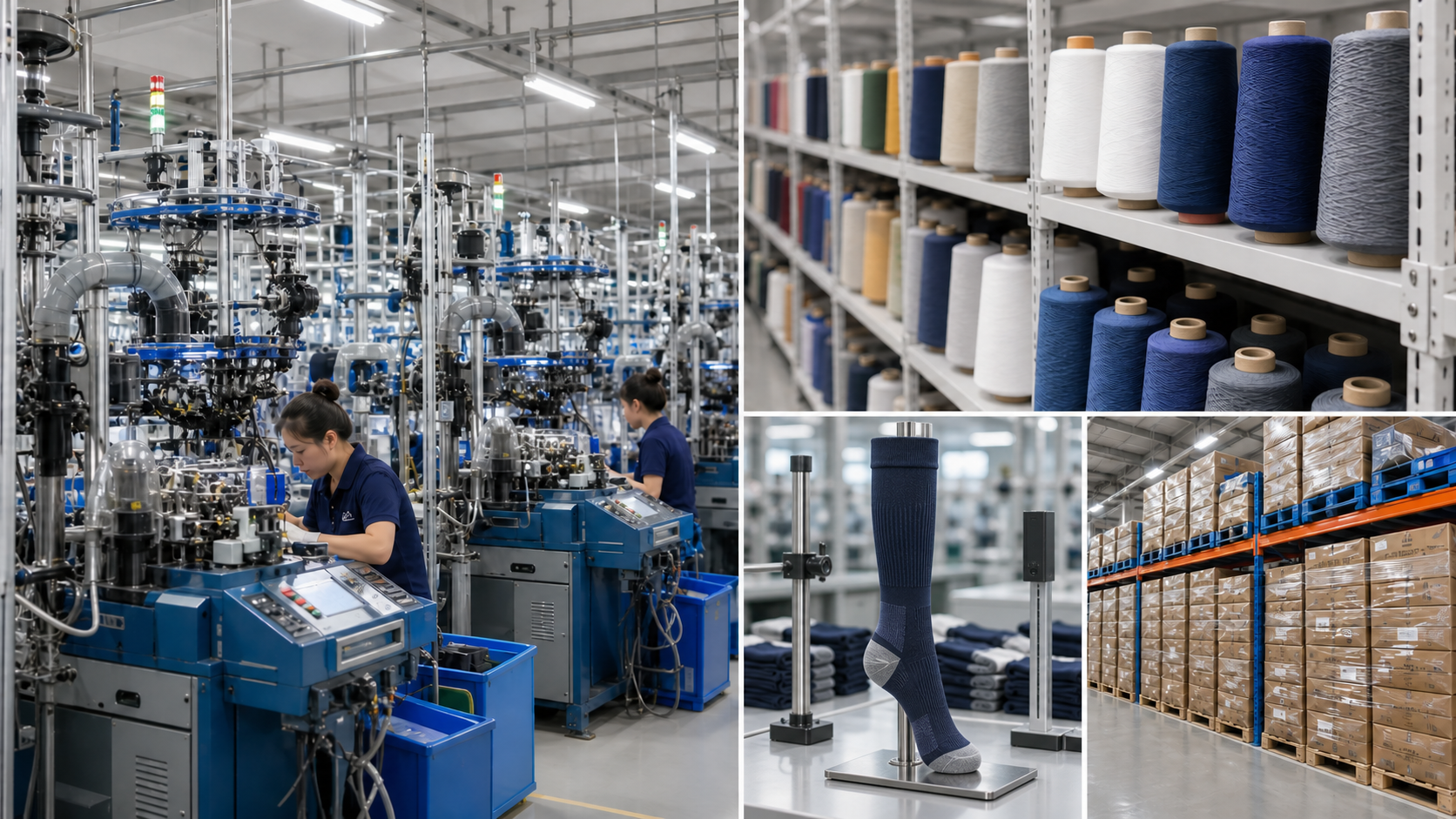
1. Turn the commercial idea into a development brief
Begin with the product's business purpose. State the target customer, destination market, intended use, retail channel, price position, expected quantity, launch timing, and whether the route is stock, modified stock, OEM, or a fully custom private-label program. These choices determine how much construction, yarn, artwork, sizing, and packaging development is required.
A useful brief also identifies the requested compression program, size architecture, material direction, colors, logo, pattern, label information, and packaging format. Reference products and mood boards can help, but they should support a written specification rather than replace it.
2. Confirm which decisions belong in the sample
The first sample should answer the highest-risk questions. Depending on the program, that may include construction, cuff feel, support zones, heel and toe position, size, material hand feel, motif scale, color balance, and logo legibility. A packaging mock-up may run alongside the sock sample when the launch schedule requires it.
Record feedback against the exact sample version. Comments such as ‘make it softer’ or ‘adjust the pattern’ become useful only when they identify the approved reference, requested change, and item that needs another review.
3. Lock the specification and approval reference
Before bulk production, align the physical approval sample with the written specification. The composition, compression construction, sizes, measurements, colors, artwork, logo, labels, care information, packaging, SKU structure, and carton assortment should describe one finished product.
Our stock blend is declared as 65% nylon, 30% polyester, and 5% spandex. Custom bamboo fiber, merino wool, and COOLMAX® programs can be developed with buyer-approved ratios. Whatever route is selected, the composition must remain consistent across the sample, production document, label, and sales copy.
4. Manage bulk production with defined checkpoints
Bulk production should follow the approved version rather than reopen development decisions. Agree on the relevant checks for yarn, knitting appearance, dimensions, construction zones, color, pattern placement, logo, pairing, labels, and packaging. Any program-specific test or destination-market document should be written into the order before production begins.
The buyer should also confirm how changes will be handled. A substitution, artwork revision, or packaging update needs written approval so the production record stays clear.
5. Review the packed product before shipment
The final review should represent what the customer or distributor will receive: the correct sock, size, colorway, pair presentation, label, barcode, packaging, assortment, and carton marking. This catches errors that a sock-only inspection cannot see.
- Final quantity by size, color, design, and packaging variant
- Approved labels, barcodes, hangtags, pair bands, pouches, or boxes
- Carton assortment and shipping-mark requirements
- Agreed inspection records and shipment documents
Bring the brief
Ready to make it sample-ready?
Send the product concept, target market, compression direction, size range, quantity, artwork, material, and packaging needs. We can turn them into a sample-ready OEM brief with clear approval points.